
Browse East Hempfield Township City Directory Shelves
LancasterHistory documents the strongest directory run for this research: annual city and county directories from 1843 through 1922. The material is city and county focused, so a Township address or a place such as Landisville, Salunga, Rohrerstown, Centerville, or a rural route must be checked against the particular volume. Lancaster Public Library also holds directory microfilm, but its inspected collection page does not publish a complete year-by-year shelf list. That difference is useful: use the documented annual run where it fits, and ask the Library Local History desk to confirm a selected volume.
| Collection | Documented coverage | Where held | Access and caution |
|---|---|---|---|
| LancasterHistory city and county directories | Annual 1843–1922 | LancasterHistory Research Center and digitized groups | Search the scan, then record title, edition year, and page. |
| PowerLibrary directory group cd01 | 1843–1900 | Digitized Lancaster directory collection | Volume-level Township inclusion needs confirmation. |
| PowerLibrary directory group cd02 | 1901–1914 | Digitized Lancaster directory collection | Use the printed page, not a search snippet alone. |
| PowerLibrary directory group cd03 | 1914–1922 | Digitized Lancaster directory collection | Check the volume’s title and coverage before assigning an address. |
| Library directory microfilm | Years not published on the inspected Library page | Lancaster Public Library Local History microfilm | Confirm publisher, year, and place coverage with the collection. |
The digitized shelves are cd01 for 1843–1900, cd02 for 1901–1914, and cd03 for 1914–1922. Each link leads to a collection group, so the selected volume still needs to be opened and checked.
The documented sequence creates a practical timeline: 1843 opens the LancasterHistory annual run, the three digital groups divide it into 1843–1900, 1901–1914, and 1914–1922, and 1922 closes that stated run. It does not prove that every volume includes every East Hempfield household.
Read East Hempfield Township City Directory Scans
The digitized groups make it possible to work from an actual scan rather than a bare database label. LancasterHistory identifies a searchable 1871 Directory of Lancaster City example as a 158-page Lancaster City and County residential and commercial directory. That example supports a citation practice, not a claim that every Township location appears in every city and county volume. Search surname variants and a place name, then open the selected image and preserve its printed context.
PowerLibrary’s 1843–1900 directory collection is the source shown in this first digitized-shelf capture.
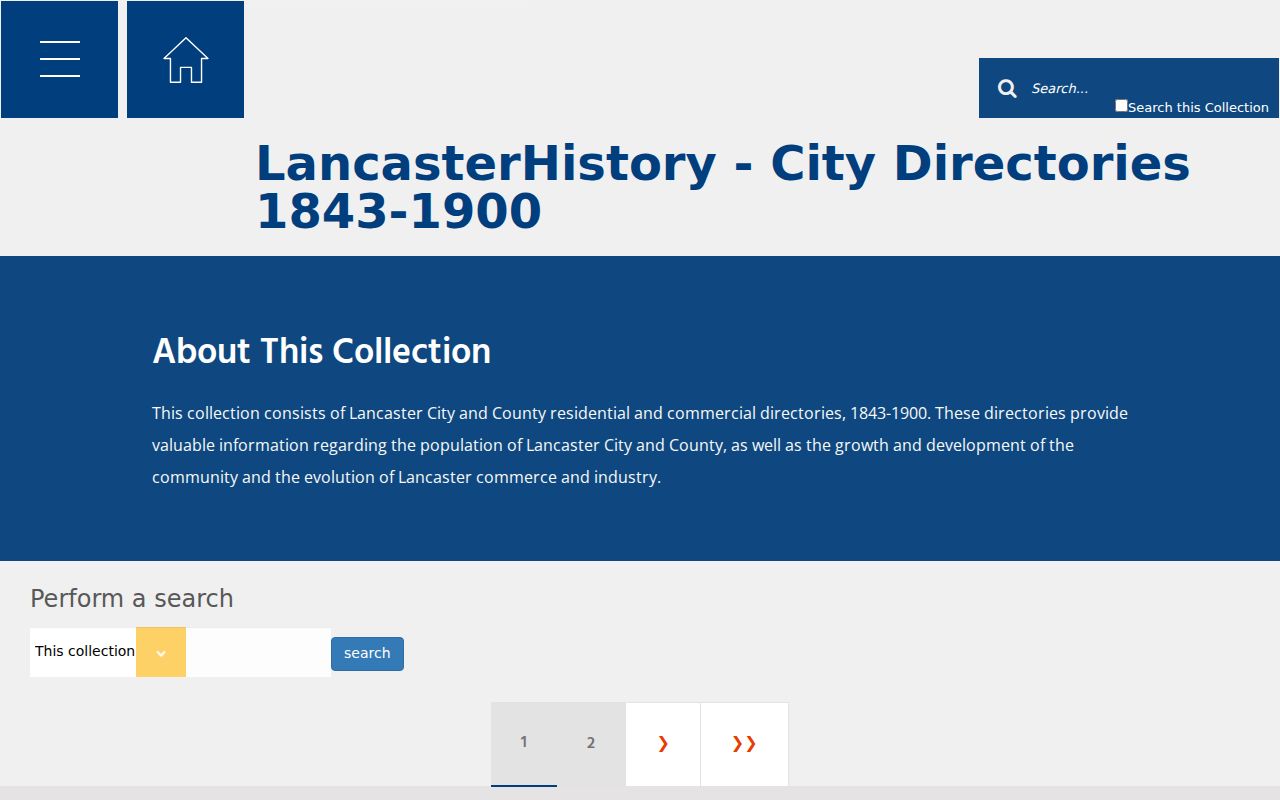
The early group supplies a focused place to inspect a selected year, while its own title page and front matter determine how that volume should be cited and read.
PowerLibrary’s 1901–1914 directory collection is shown in the later-period capture below.
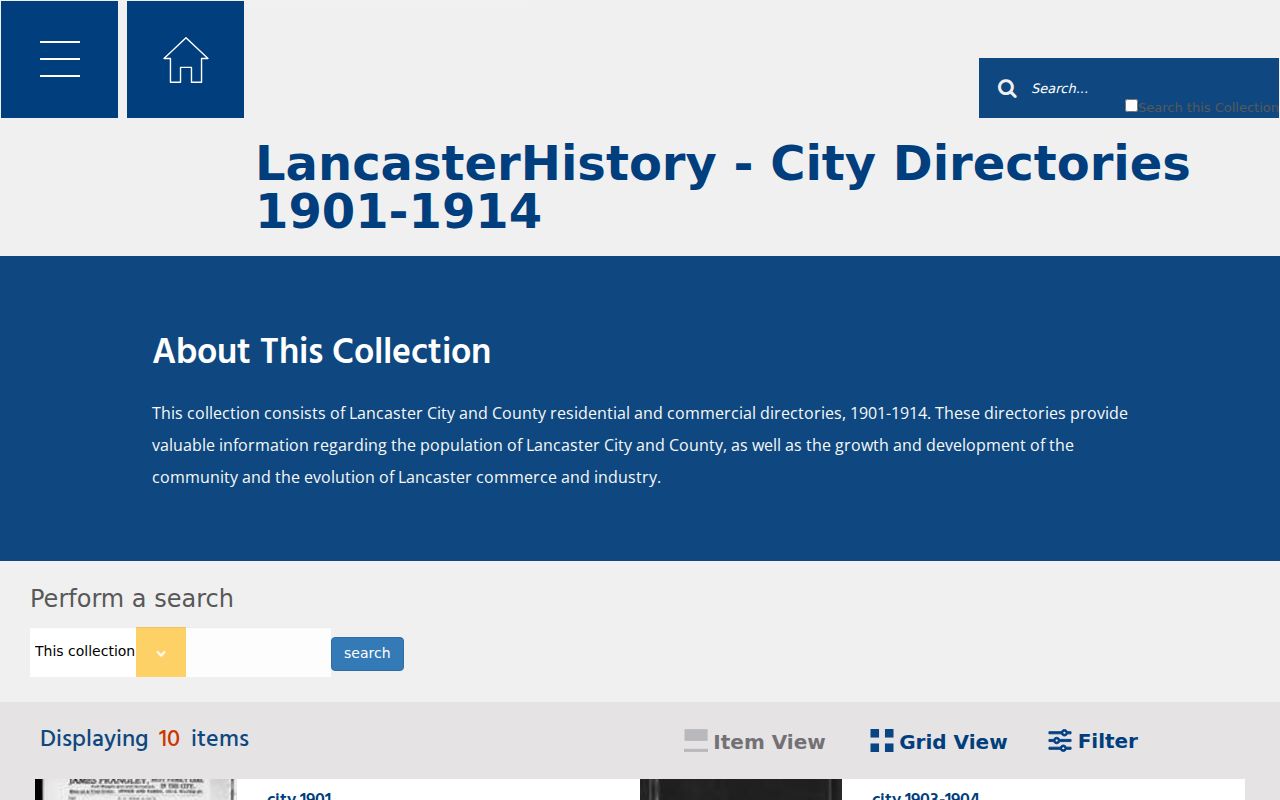
For either digital shelf, note the edition year and page before comparing a name with tax, census, map, or Recorder evidence.
Read an East Hempfield Township Directory Entry
No particular Lancaster directory entry, publisher convention, or abbreviation key was inspected for this project. That means an entry inventory must remain a check-the-volume protocol rather than a made-up sample. A name search result is only the opening. The printed page can show a residence, a business listing, or another indexed reference, and its meaning depends on the volume’s own instructions.
| Title page | Record the full title, publisher, edition year, and the stated geographic scope. |
|---|---|
| Page reference | Write down the printed page number or scan location so the entry can be revisited. |
| Exact entry text | Transcribe only after opening the scan, keeping the spelling and punctuation visible in the volume. |
| Abbreviation key | Find the volume’s own key before interpreting initials, marks, or shortened address text. |
| Index order | Determine whether the page is arranged by name, address, business, or another scheme. |
| Listing type | Confirm whether it is a residence, business, or another kind of reference before using it in a household trail. |
- Printed directory
- A dated publication that can list names and addresses within its stated coverage. It is not a complete Township roll.
- Criss-cross directory
- An address-arranged format that can help reverse a location to a listing. No East Hempfield run has been verified here.
- Householder index
- An index organized around a household or address convention, when the particular volume provides one.
- Abbreviation key
- The volume’s explanation of its shorthand. Read and cite it before assigning a meaning to an entry.
That caution preserves the real value of printed volumes. An address can guide later checking, but it is not an automatic present-day identification or a substitute for the official record systems.
Use East Hempfield Township Local History
Lancaster Public Library serves East Hempfield among its fourteen municipalities. Its Local History collection lists directory microfilm, Lancaster County census microfilm from 1790 through 1930, local newspapers on paper and microfilm, local histories, atlases, selected family histories, selected church and cemetery records, and a small passenger-list collection. These are useful neighboring sources when a directory entry is missing, vague, or tied to a former community label.
Lancaster Public Library Local History provides the holdings route represented below.
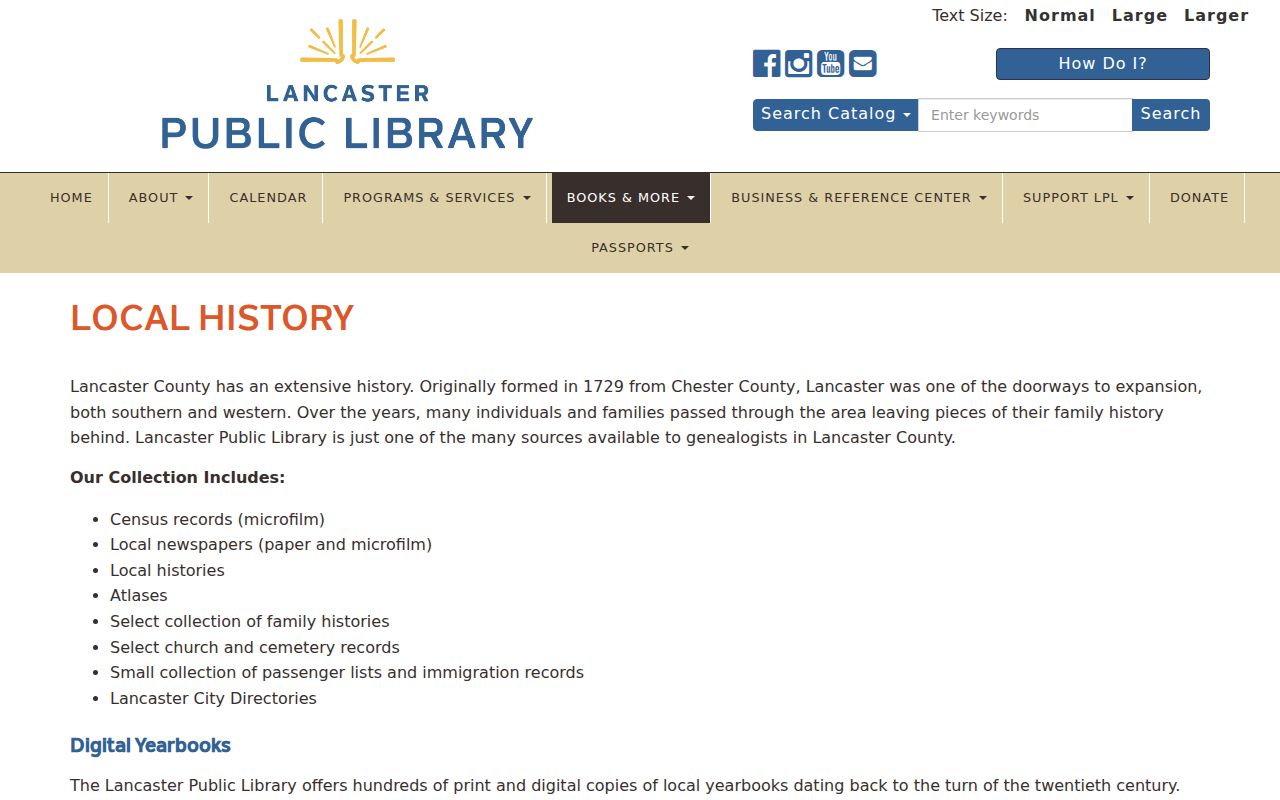
The Library’s published list supports a request for a specific surname, address, community, and year. The Lancaster City Branch is at 151 N. Queen Street, and the published hours are Monday–Tuesday 9 a.m.–7 p.m., Wednesday–Thursday 9 a.m.–8 p.m., and Friday–Saturday 9 a.m.–5 p.m. Its public page does not provide a complete catalogue-derived list of directory publishers or reverse-directory years.
Pair East Hempfield Township Directory Records
East Hempfield tax books at LancasterHistory extend from 1847 through 1939. They can add Township and year context alongside a directory, but a tax listing is not automatically proof of ownership or ordinary residence. The Library’s searchable and browseable Hempfield School District yearbooks run through 1988 and offer school-era context. LancasterHistory’s digitized newspapers add a title, date, and page route for local context, rather than a shortcut to identity.
POWERLibrary collections is the source for the yearbook route in this capture.
A yearbook can corroborate a school-era association after a surname and year are checked, but it cannot establish a person’s current location.
LancasterHistory Research is shown below and is the access channel for the organization’s directory and tax-record context.

The Research Center is at 230 N. President Avenue, Lancaster. Its listed contact is research@lancasterhistory.org and 717-392-4633 ext. 126. Ask about the annual directory run, the East Hempfield tax books, archival context, and a specific volume or page.
Trace an East Hempfield Township Household
Work forward and backward through the printed collection with a written log. The strongest trail pairs a directory year with other records close to that date, rather than treating a single name match as final. If the record period moves across the Township’s predecessor boundary, change the place search as well as the year.
- Choose a surname variant, a community label, and a first target year. Confirm that the selected volume’s coverage could include that place.
- Open the scan and record the title page, edition year, printed page, exact entry, and the volume’s abbreviation key.
- Check the nearest Lancaster County census microfilm period for household and geographic context, keeping the enumeration date separate from a mailing address.
- Compare a relevant East Hempfield tax book year, Recorder document, or historic map layer when a land or property connection is needed.
- Use a dated newspaper item, probate record where publicly accessible, or a yearbook as corroboration, then log what each source does and does not establish.
A person disappearing from one directory can mean a move, a changed place label, a different spelling, omitted coverage, or a volume that never included that area. Check the next available volume and supporting records before treating absence as a conclusion. When the question becomes a current parcel trail, use the East Hempfield Township street directory for the modern address-keyed route.
Search Predecessor Hempfield Records
East Hempfield did not hold its present name for the full county record period. Original Hempfield was created in 1729 and later gave rise to areas including Manor, Columbia, Mountville, West Hempfield, East Petersburg, and East Hempfield. For material before the 1818 and 1819 period, search Hempfield, not East Hempfield alone. The place name on a directory, assessment, map, or deed may reflect the historical jurisdiction rather than the present Township label.
The State Archives guide lists predecessor Hempfield assessment records for 1751–1818 and early East Hempfield assessment records beginning in 1819. LancasterHistory tax books then continue the local context from 1847–1939. This is an evidence-based change in search term, not a claim that every family appears in each series.
Place East Hempfield Township Finds in Time
LancasterHistory’s digitized newspapers can add a dated local context to a careful directory trail. Its listed runs include the Lancaster Intelligencer Journal from 1847–1922, the Lancaster Daily Intelligencer from 1864–1928, and other local titles with their own documented dates. Search an exact or variant name with a place and narrow date. Cite the title, date, and page rather than relying on a result snippet.
LancasterHistory digitized newspapers is the source shown in the assigned collection image.
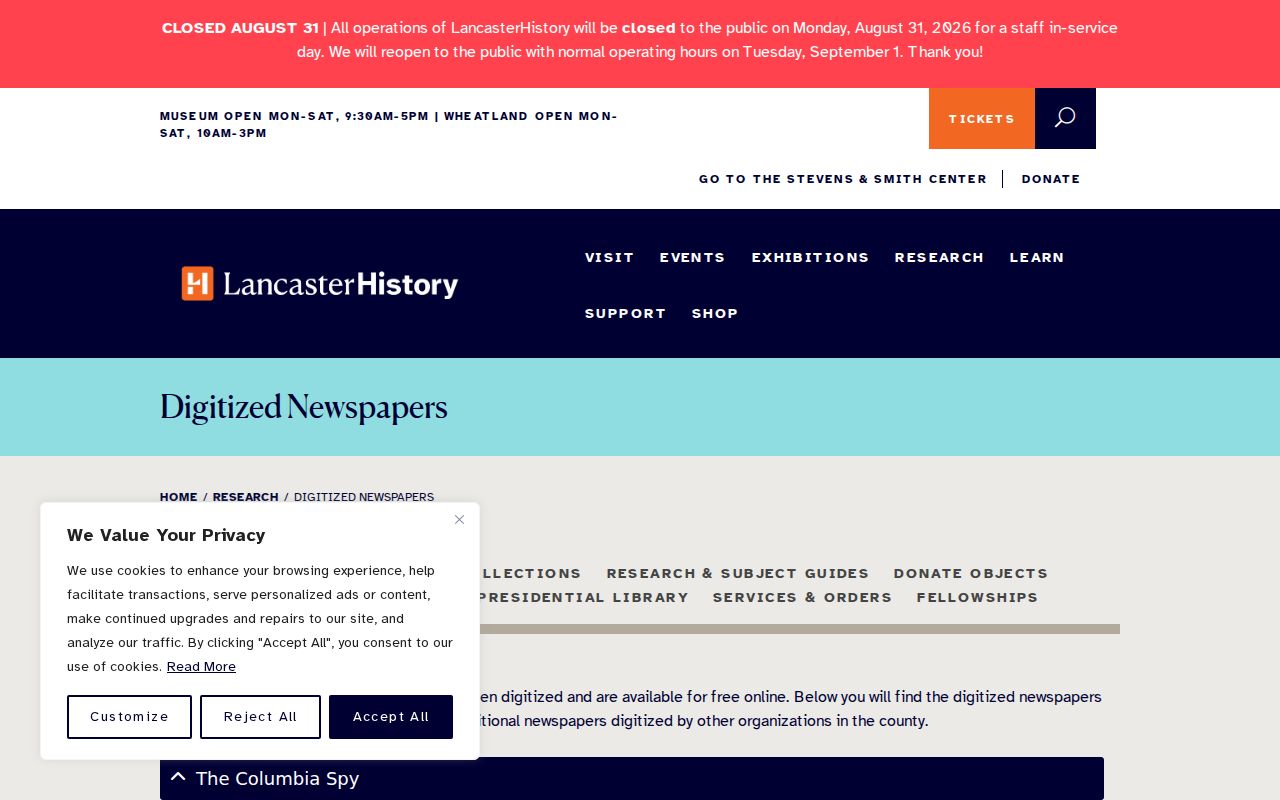
A newspaper item can support a date or local context, but it should be compared with the original directory page and other records before it is used to connect people or properties.
East Hempfield Township City Directory Limits
Published directory volumes are snapshots, not complete public resident lists. Their scope may favor Lancaster City or another stated area, and an East Hempfield name can be absent because of geography, spelling, rural-route practice, or editorial choice. School yearbooks and newspapers have their own dated and collection-specific limits. Tax, map, deed, and census materials answer different questions and should be labeled that way in a research log.
County and Township records can remain unavailable online, restricted, or simply outside a directory’s coverage. When a source fails to answer a material question, ask the holding institution for its documented access route and verify the original record before relying on an interpretation.